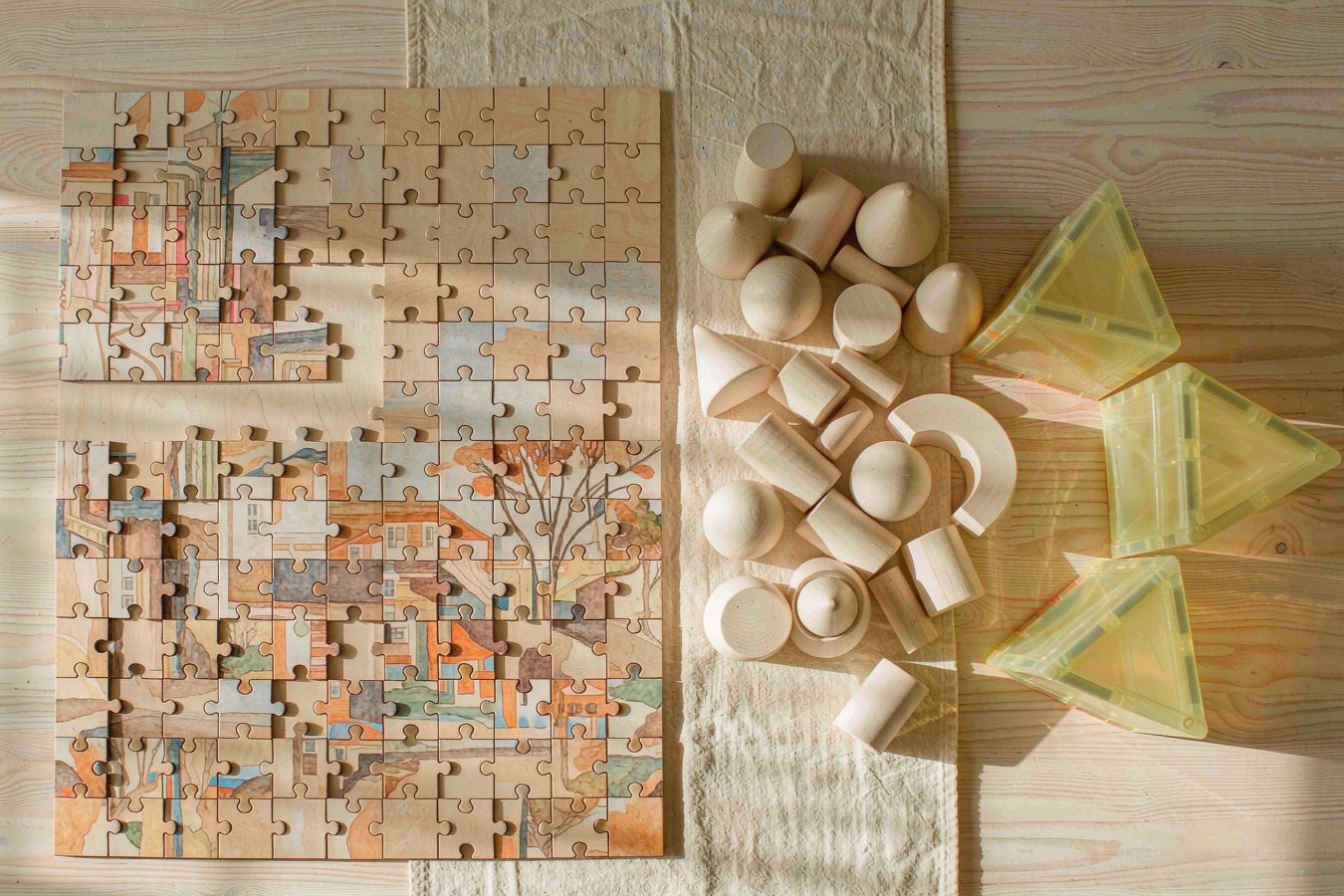
Walk down any toy aisle and blocks and puzzles are shelved together under the same promise: spatial reasoning, problem solving, fine motor skills. All true. But they ask the brain to do opposite things, and mixing them up is why some kids take to one and refuse the other.
Two kinds of thinking
A puzzle is convergent. There is one correct answer, the pieces either fit or they do not, and the feedback arrives instantly and without ambiguity. You cannot negotiate with a jigsaw.
Blocks are divergent. There is no answer key. The only feedback comes from physics, and physics does not care whether the tower looks good.
A puzzle teaches you to find the answer. Blocks teach you that there might not be one.
That difference is not cosmetic. It maps onto two different relationships with being wrong.
What puzzles actually teach
The value of a puzzle is not the finished picture. It is the loop:
- Notice something does not fit
- Form a hypothesis about why
- Test it
- Adjust
Run that loop forty times and you have practised tolerating being wrong at a low cost, which is a skill that transfers to almost everything. Puzzles also train scanning and edge detection, the habit of sorting by shape and colour before trying to place anything.
The other thing puzzles give is a reliable win. There is a moment when the last piece goes in and it is unambiguous. For a child who is currently failing at something else, that matters more than the spatial reasoning.
What blocks teach
Blocks do not teach you to find the answer, because there isn’t one. They teach structural thinking: what bears load, how far something can span before it sags, why the wide base matters. They also teach the idea that multiple solutions can be valid, which is harder to demonstrate and harder to test.
There is no completion state with blocks. That is a feature. A child who builds for twenty minutes and then knocks it down has not failed to finish, they have run the experiment.
Which one your kid needs
The choice is less about age than about how the child currently handles frustration.
The child who quits the moment it gets hard. Start with puzzles of 30 to 60 pieces, large format, floor size. Big pieces mean visible progress. The goal is to get through the loop enough times that being wrong stops feeling like a verdict.
The child who finishes everything immediately and asks for more. Move up in piece count, or move to blocks. A puzzle they can finish in one sitting has stopped offering the loop.
The child who builds one thing and never varies it. More blocks, and fewer speciality pieces. If half the set is a single custom-moulded wall panel, there is only one thing to build with it.
The child who will not touch either. Try magnetic tiles. They hold themselves together, so the failure mode is gentler, and three year olds can succeed on the first attempt.
If you want a starting point in each camp, the Giant Floor Puzzles set of 4 covers the puzzle side without asking for much patience, and the Magna-Tiles Coral Reef set does the same for building.
The building-toy landscape, briefly
Wooden blocks. Best from about one to four years. No wrong way to use them, heavy enough to feel like real objects, and they survive being thrown. The limit is that they only stack, so the structural vocabulary tops out early.
Magnetic tiles. Roughly three and up. The fastest path to success of any construction toy, and unusually good for geometric intuition, since the shapes have to close. Expensive per piece, and the magnets demand supervision with younger siblings.
Interlocking bricks. Five and up. Come with instructions, and the pleasure is partly the manual, partly the moment the mechanism works. The downside is that sets are increasingly single-purpose kits rather than building material.
Planks and connectors. Four and up. Open-ended like blocks but with real engineering constraints, so they reward iteration instead of luck.
Buy one set that is big enough
The most common purchasing mistake is buying four small sets instead of one large one. A 40-piece set of every category means you can build something the size of a shoebox in four different ways. One 200-piece set means you can build something the size of the child, which is the thing they actually want to do.
Depth of one material beats breadth of four.
Leave a Reply