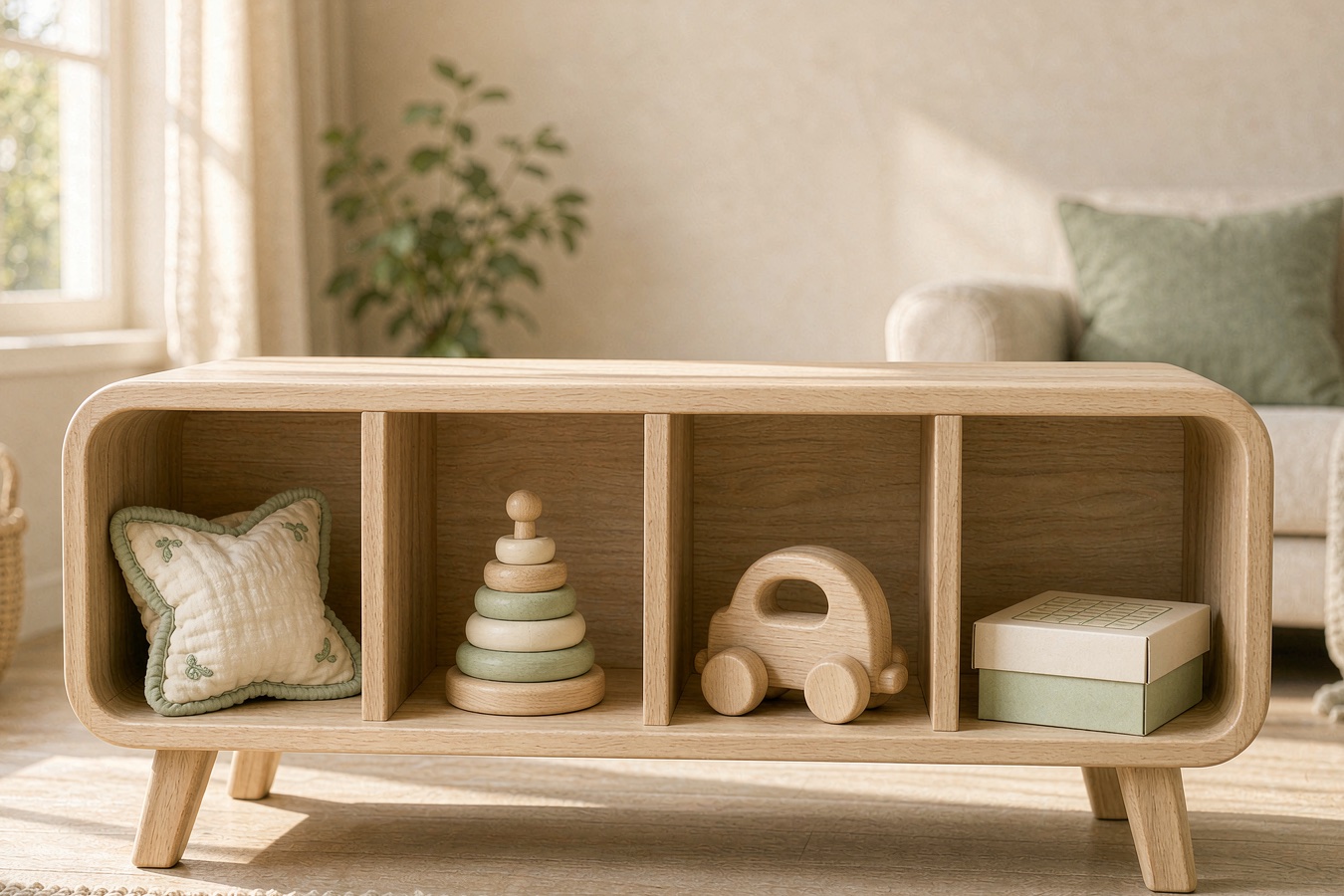
The number on the box is a legal minimum, not a recommendation. It tells you when a toy stops being a hazard for a child of that age. It says nothing about whether your kid will want it, and it definitely says nothing about whether they will still want it in three weeks.
That gap is where most toy buying goes wrong. A four-year-old gets a set rated 8+, loses interest in an afternoon, and the conclusion drawn is that the child is difficult. Usually the toy was simply aimed at a different stage.
What follows is what tends to hold attention at each stage, what to skip, and why.
0–12 months: the world as an experiment
At this age the toy is a physics test. Drop it, it falls. Squeeze it, it makes noise. The point is not to teach anything specific. The point is to let them confirm, over and over, that the world responds to them.
What works: high-contrast fabric, crinkle paper, a couple of chunky wooden pieces light enough to lift, anything that can be safely mouthed. One object at a time is plenty. A baby surrounded by six toys is not being enriched, they are being interrupted.
What to skip: battery toys that perform while the baby watches. These invert the relationship. The toy does the playing and the baby becomes the audience, which is the opposite of what this stage is about.
The practical check for anything this age: if it fits through a toilet paper tube, it is a choking risk.
1–2 years: in, out, and on top
The obsession here is containment. Putting things into containers, taking them out again, stacking, and knocking down. It looks pointless. It is the foundation of object permanence, cause and effect, and eventually sorting.
A bucket and four blocks will outperform a light-up activity table most days, and it is not close.
What works: nesting and stacking toys, first shape sorters with forgiving tolerances, push-along toys that stay upright when shoved, board books with flaps sturdy enough to be yanked.
Buy fewer pieces and bigger ones. Small parts are both a choking risk and a losing battle against the vacuum cleaner.
For that age bracket a chunky Wooden School Bus or the Tender Leaf Farm Playset tends to earn its shelf space, mainly because nothing in it can be swallowed and everything in it can be dropped.
3–5 years: the pretend peak
This is the window where a cardboard box becomes a spaceship and stays one for an hour. Symbolic play is doing real work: rehearsing social situations, testing language, sequencing events, trying on being someone else.
This is also the age where the widest range of toys becomes viable at once, which makes it the easiest age to overbuy for.
What works: dress-up, play food, doctor and vet kits, dollhouses, simple figure sets, and building toys that come without instructions. Anything with a wrong way to use it is doing its job.
A doctor kit is a good test case. It gets used for doctoring, then for vet visits, then for running a shop, and eventually for a hospital that treats dinosaurs. That range is the entire point.
What to skip: heavily scripted toys tied to a single film or series. They usually encode one correct play pattern, kids exhaust it in a week, and then you own a plastic monument.
6–8 years: rules with consequences
Play turns competitive and rule-bound around here. Losing becomes a real event that has to be learned to handle. Games with genuine strategy start to land, and building sets with an actual mechanism inside them, gears or motors or something that bears load, become satisfying in a new way.
What works: board games that punish bad decisions more than bad luck, mid-size building sets, kits with a finished object at the end, decent sports equipment, magic sets, anything with a skill curve.
This is the age to stop buying “toys” and start buying equipment.
A set like the Melissa & Doug Big Rig Truck set sits right at that boundary. It is a toy truck, but the assembly is the interesting part, and the finished object survives being played with afterwards.
9–12 years: skill and identity
Older kids want things that prove something, either that they can build it, solve it, or that it reflects who they are. The category that works is closer to tools than toys.
What works: complex builds, electronics and coding kits, model kits, strategy games with long tails, art supplies that are not the children’s version, proper sports gear.
What to skip: anything that talks down. A ten-year-old can spot a product designed for a seven-year-old with a bigger logo on the box, and the contempt is instant and permanent.
Three things worth skipping at any age
- Toys with one button. A single interaction has a very short half-life, no matter how good the sound effect is.
- “Educational” on the box. The word is unregulated. Look at what the toy actually does instead.
- Sets that need a screen to be fun. If the tablet is the interesting part, you have bought a tablet accessory.
A note on quantity
The most common mistake is not the wrong toy, it is too many of the right one. A shelf with twelve toys gets each of them about eight percent of the attention. A shelf with four gets twenty-five percent each, and children go deeper into fewer things.
If you want a rule: one thing to build, one thing to pretend with, one thing to read, one thing to take outside. Refill when something breaks, not when something new appears.