
Category: Safety & Care

  • The age label is a hazard warning, not a difficulty rating

    The age label is a hazard warning, not a difficulty rating

    The age recommendation on a toy box is widely read as a difficulty rating, and it is not one. It is a hazard statement. The number is the age below which the toy presents a specific, defined risk, and in most countries that definition is narrow and mechanical.

    Understanding what it actually measures tells you what to check yourself, and what the label does not cover.

    What "3+" actually means

    In the United States, the 3+ threshold is tied to the small parts regulation: a toy intended for children under three cannot contain a piece that fits entirely inside a specified cylinder, because such a piece can be swallowed and block an airway. The European standard uses an equivalent test.

    So a 3+ label means, roughly: this toy contains small parts. It does not mean the toy is too intellectually demanding for a two-year-old. Plenty of two-year-olds would love it, and would also put a wheel in their mouth.

    The practical consequence is that a 3+ toy bought for a three-year-old with a one-year-old sibling in the house is a hazard, because the label was evaluated for the buyer, not for the household.

    What tends to suit each stage is a separate question, and we cover it in the age guide. This piece is only about what can go wrong.

    The four checks that matter more than the label

    The tube test. Anything that fits through a toilet paper tube is a choking risk for a child under three. This is a close approximation of the regulated cylinder and it takes two seconds.

    Magnets. This is the most serious hazard in the toy category and the least understood. A child who swallows two or more small high-strength magnets can have them attract each other across loops of intestine, which is a surgical emergency. This is why high-powered magnet sets carry 14+ labels even though they are intellectually suitable for much younger children. If a magnet set is in the house, count the pieces.

    Button batteries. A coin cell lodged in the oesophagus causes chemical burns within a couple of hours. Anything battery-powered needs a screw-secured compartment, checked, not assumed.

    Strings and cords. Long cords are a strangulation risk for infants. Anything with a cord longer than about 22 centimetres should not be in a cot or playpen.

    Materials: what to actually look for

    Wood. Most wooden toys are sealed rather than bare, and the sealant is what you are buying. Water-based finishes and EN71 or ASTM compliance are the things to check. Bare unfinished wood is fine and can be sanded, but painted wood with chipping edges is worth retiring.

    Plush. Safe from birth if there are no loose parts. The failure point is eyes and noses fixed with a stalk rather than a locked washer, and those come off. Squeeze them.

    Recycled plastics. Perfectly reasonable, and the same standard applies. Recycled content does not change what the toy does if a piece breaks.

    Hand-me-downs deserve a real inspection

    Second-hand toys are the best value in the category and the highest-risk, because nobody inspected them. Five things to check before they go into the toy rotation:

    1. Any crack that could produce a sharp edge
    2. Loose or missing eyes, buttons, wheels
    3. Magnet sets with missing pieces, which are not usable and not repairable
    4. Battery compartments that no longer close properly
    5. Recalls. A quick search on the model name takes a minute and occasionally matters.

    The general rule is that a toy which has lost a part is not a slightly worse toy. It is a different object, and it needs to be re-evaluated as one.

    Supervision is not a substitute for the right toy

    The instinct when a toy is slightly too old is to say “I’ll watch them”. This works about as well as watching is reliable, which is to say intermittently. The better move is to buy for the youngest child in the house and let the older one use it, rather than buying for the oldest and relying on vigilance.

    A short version

    • The age label is about choking, not difficulty
    • If it fits through a toilet paper tube, it is a hazard under three
    • Count the magnets, every time
    • Check the battery compartment actually secures
    • Inspect hand-me-downs as if they were new, because nobody else did
  • After the box is gone: storage that survives a week

    After the box is gone: storage that survives a week

    Every storage system works on the day it is installed. The test arrives about a week later, when three sets are open on the floor at once, a four-year-old has moved on to something else, and the tidying job has grown large enough that nobody starts it.

    Most storage advice fails because it treats the problem as volume. It usually is not. It is mixing.

    The real problem is pieces migrating

    A train set missing two couplings is not a train set. It is a pile of wood. The set lost value not because a piece broke, but because a piece ended up in a different container from the rest of it.

    Fixing this fixes about eighty percent of toy chaos, and it costs nothing:

    One container per set. Not one bin for all the building toys. One container for the train, one for the blocks, one for the play food. When a set has a home, putting it away is a single action rather than a sorting task.

    Sets with a lot of small parts get a container with a lid, and the lid matters. It means the container can be carried, tipped, and put away without a second trip.

    Shallow beats deep

    A deep bin is a bag. Things go in and do not come out, because finding anything requires digging, and nobody digs.

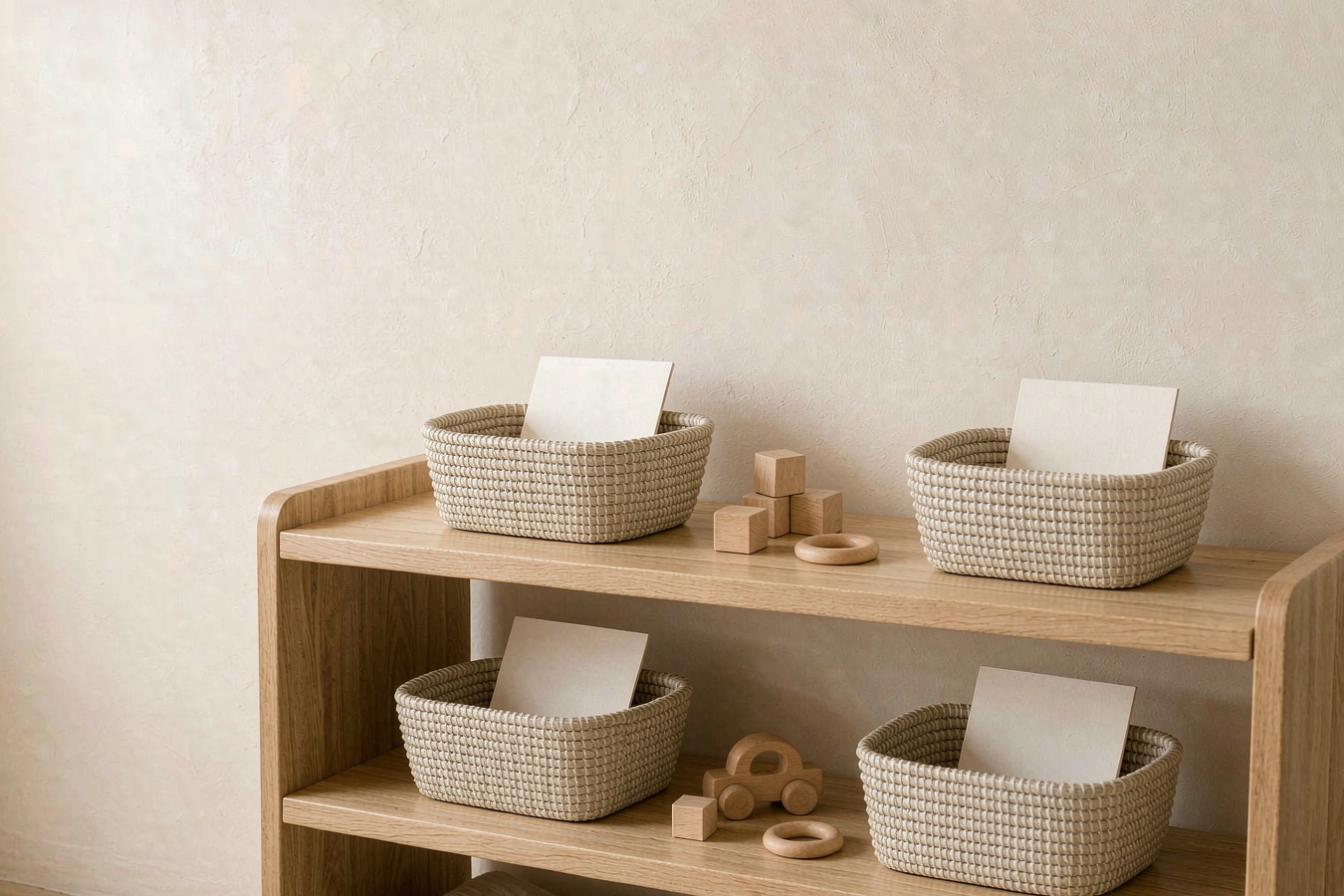
    Shallow trays and open baskets at child height get used, because the contents are visible from above and the whole set can be taken in at a glance. The practical depth is roughly one layer of toys.

    The same rule explains why a low open shelf outperforms a toy chest almost every time. The chest holds more. The shelf gets used.

    Label with a photograph, not a word

    Words do not work for a child who cannot read, and by the time they can read, the system has already collapsed. Photograph the set laid out flat, print it small, tape it to the front of the container. That is the whole labelling system.

    The reason to photograph the set rather than the container is that the image needs to answer “what is in here”, and a picture of a basket does not answer that.

    The rotation box

    Take roughly a third of the toys and put them away somewhere out of reach. Swap them back in about once a month.

    This is not minimalism and it is not about discipline. It is about the fact that a large part of novelty is simply forgetting. A toy that comes back after six weeks is encountered almost as a new toy, and the effect is reliable enough to plan around.

    The rotation box also gives you a low-cost answer to “we have too much stuff”: whatever is in the box when you next swap has been unused for a month, and that is real evidence rather than a guess.

    Where things go, by height

    • Lowest shelf, child height: whatever gets used daily. Blocks, figures, the current favourite book.
    • Middle: sets that need a bit of setup, or that are used a few times a week.
    • Top shelf, out of reach: anything with small parts that a younger sibling should not reach, art supplies, and the rotation box.

    This is the one piece of storage advice that is actually about safety. Choking hazards belong above the reach of the youngest child in the house, not above the reach of the oldest.

    The ten-minute reset

    A tidy-up that takes forty minutes will not happen. The reset needs to be short enough to be boring.

    The version that works: put on one song, and the rule is that sets get closed before loose pieces get picked up. Container first, then the floor. Doing it in that order means the floor is being sorted into existing homes rather than into a new pile.

    Anything that has no home at the end of the song gets one, or leaves.

    What actually helps to buy

    • A low open shelf. The single highest-value piece of furniture for a playroom, because it makes the whole system accessible.
    • One container per set, shallow, ideally see-through or open-topped.
    • One large lidded box for miscellaneous. Every house needs exactly one, and it should not multiply.

    The Scarlet corner shelf and the smaller Sparrow shelf are both built around that height rule, which is the part that actually matters. Baskets matter less than where they sit.

    That is the whole system. It works because it is small enough to maintain on a Tuesday, not because it is clever.