Category: Product Notes

Close looks at individual toys — what is in the box, who it suits, and what to check before you buy.

  • The Doll Center That Fits 15- to 18-Inch Babies

    The Doll Center That Fits 15- to 18-Inch Babies

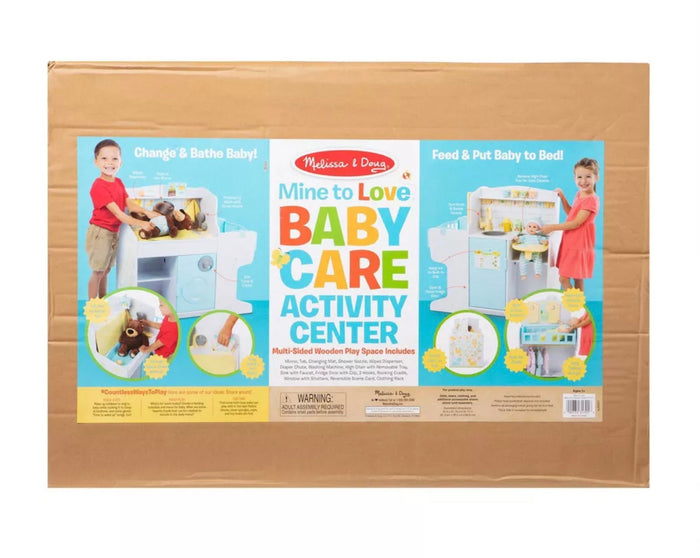
    This wooden centre gives a doll three rooms in one footprint: a kitchen with refrigerator, sink and high chair; a bath-and-changing area with tub, spray nozzle and flip-down mat; and a nursery with a rocking cradle. It is sized for dolls and stuffed animals from 15 to 18 inches tall. Dolls and accessories are not included. It is aimed at ages three to six.

    The doll size is the first thing to check

    Fifteen to eighteen inches is the range that covers most play dolls — baby dolls, most 18-inch dolls, and a fair number of stuffed animals. It does not cover dolls-house figures, which are far too small for the high chair and will fall straight through, and it does not cover the largest toddler dolls, which will not sit down in the cradle.

    Measure the doll you actually own before ordering. This is the single most common reason a purchase like this disappoints, and it takes thirty seconds with a tape measure.

    Three zones, and why the small details matter

    The kitchen side is straightforward: fridge, sink, high chair. The bath area is where the design effort went — a tub with a spray nozzle, a changing mat that flips down, a mirror, a wipes dispenser, a diaper disposal chute, and a washing machine with a dial that clicks as it turns. The nursery holds a rocking cradle, storage for clothes, and a shuttered window with a card that reverses between a day scene and a night scene.

    That night card is a small thing that changes the play. It gives a child a reason to put the doll to bed rather than just to hold it, which is how a five-minute activity turns into a forty-minute story.

    What you still have to buy

    No dolls, no bottles, no clothes, no diapers. The centre is the furniture, not the play set. Budget for at least one doll in the 15-to-18-inch range — a 14-inch drink-and-wet bath baby pairs naturally with the tub — plus a couple of outfits if the child is going to use the clothing storage.

    Assembly and floor space

    It arrives flat and needs assembling with a Phillips screwdriver, which is not included. The shipping weight is around 6.8 kg, so it is a two-person lift once built and not something you will move between rooms casually. Plan a corner where it can stay: this is furniture, not a toy that goes back in a box.

    Doll size15 to 18 in.
    Age3 to 6 years
    IncludesKitchen, bath and changing area, nursery
    Not includedDolls, accessories, screwdriver

    Two questions that come up before buying

    Will an 18-inch doll fit? Yes — eighteen inches is the top of the stated range, so a standard 18-inch doll sits in the high chair and the cradle, but with no room to spare. A 19-inch doll will not. Measure rather than assume, because “18-inch doll” covers a range of actual body shapes.

    What do I need on day one? A doll between 15 and 18 inches, and at least one change of clothes, because the clothing storage is otherwise an empty drawer and the dressing play never starts. Bottles and diapers are optional; the doll is not.

    The Melissa & Doug Baby Care Activity Center is in stock now. More doll-sized furniture sits in the baby and toddler range.
  • Before You Buy a 1:14 RC Car: 9 km/h, 30 Metres

    Before You Buy a 1:14 RC Car: 9 km/h, 30 Metres

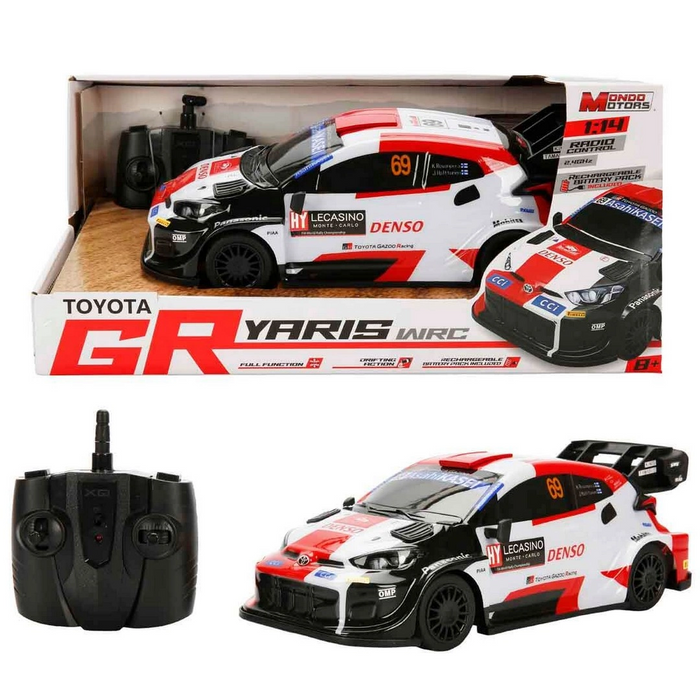
    This 1:14 Toyota GR Yaris WRC does about 9 km/h with a 30-metre range on a 2.4 GHz signal. The car itself is 28 cm long and runs on a 3.7 V 500 mAh lithium-ion pack charged over USB. The controller takes two AA batteries that are not in the box.

    What 9 km/h actually feels like

    Walking pace is around 5 km/h. Nine is a fast jog — and in a hallway, at ankle height, with the car a metre from your feet, it reads as fast. Indoors, on tile or short carpet, that is more than enough throttle for a child to control. Outdoors on tarmac it is fun for about ten minutes; on grass it labours, because small wheels and a light body do not cope with soft ground.

    If you were hoping for something that tears across a park, this is not that car. Hobby-grade buggies sit in a different class entirely and require a different level of commitment, including battery management and spare parts. This is a living-room rally car.

    The 2.4 GHz detail matters more than the top speed

    Older toy RC cars ran on 27 MHz or 49 MHz and interfered with each other — two cars in the same room meant two cars on one controller. A 2.4 GHz set pairs its controller to its car, so two or three of these can run in the same hallway without crossing signals. If you are buying for siblings or cousins, that single spec is the difference between a working afternoon and a fight.

    The battery situation, stated plainly

    The car’s pack charges from USB, and the cable is included. The controller does not come with batteries. This is the single most common surprise in reviews of this class of toy: it arrives, it is unboxed in front of an excited child, and it does not work. Buy two AA batteries at the same time as the car, or better, two rechargeable AAs and a charger.

    A 500 mAh pack in a car this size gives a short session rather than an afternoon — expect to charge between runs, and expect the last two minutes of a pack to be noticeably slower than the first two.

    Where it works, and what to buy instead

    Hallways, kitchens, smooth driveways, empty car parks. The 30-metre range is generous for a house and modest for a field. If the child’s default surface is gravel or lawn, a 1:64 mini monster truck with taller wheels is the more sensible pick, and it lives in the same vehicles and RC section.

    Scale and length1:14, 28 cm
    Top speedAbout 9 km/h
    Range30 m, 2.4 GHz
    Car power3.7 V 500 mAh Li-ion, USB cable included
    Controller power2 × AA, not included

    Two questions that come up before buying

    Can two of these run in the same room? Yes. The 2.4 GHz radio pairs each controller to its own car, so two or three can run together without one controller steering two cars. That was the defining flaw of older 27 MHz toys, and it is the reason this spec is worth checking on any 2.4 GHz car.

    Does it drive on carpet? Short pile, yes, with a noticeable drop in speed. Long pile or a thick rug, no — the car sits low, the wheels are small, and it will bog down and overheat rather than run. Tile, laminate and smooth concrete are where it behaves as intended.

    The 1:14 Toyota GR Yaris WRC is in stock now. Add batteries to the order.

  • Tegu Magnetron: What 32 Magnetic Blocks Can Build

    Tegu Magnetron: What 32 Magnetic Blocks Can Build

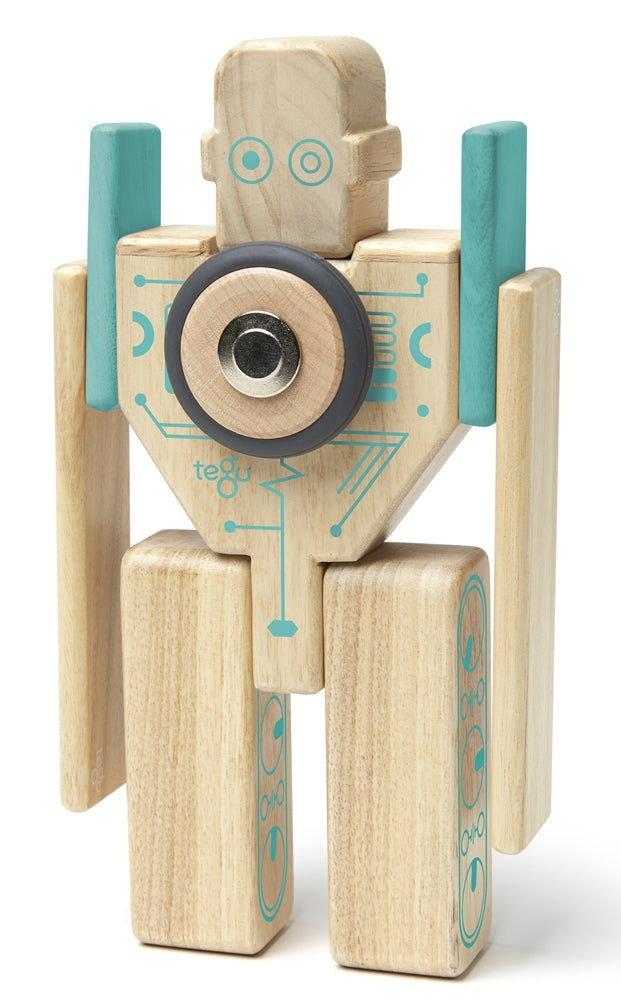
    Tegu Magnetron is a 32-piece magnetic wooden building set in 14 shapes, including a robot torso, a head, treads, wheels and two solar panels. The magnets are sealed inside the hardwood blocks, so any face will attach to any other face. It is rated for ages three and up, made in Honduras from FSC-certified hardwood.

    What 32 pieces actually build

    The set is sold as a robot, and it does stand up as one: torso, head, treads, arms from planks and triangles. But the piece list is what matters more than the intended result — four long planks, four wheels, four cubes, two parallelograms, two medium columns, a charging station, a plug and the solar panels. That is enough structural variety to build a crane with a magnetic lift, a car, or a saucer, which is exactly what the manufacturer suggests children will do once the robot has been broken down.

    Thirty-two pieces is a good number for one child building alone. It is thin for two children building separately, and it is not a “shared bucket” set. If you are buying for siblings, buy a second set or start with a smaller one and expand.

    Pieces32 across 14 shapes
    IncludesTorso, head, 4 wheels, 4 long planks, 4 cubes, treads, 2 solar panels, charging station
    MaterialFSC-certified hardwood, water-based lacquer
    Age3 years and up (contains magnets)
    OriginMade in Honduras, one tree replanted per set

    Why magnets inside wood behave differently

    There are no loose magnetic parts, no clips and no connectors to lose. Each block is a sealed wooden shape with magnets embedded beneath the surface, which means the pieces either snap or push away — there is no wrong way to hold them. That repulsion is useful: a child learns orientation by feel within a few minutes, because the block physically refuses to go on backwards.

    The flip side is the warning printed on every set of this type. Swallowed magnets are a genuine medical emergency, which is why the age rating is three and up rather than eighteen months, and why this is not a set to leave out with a toddler in the house.

    The sustainability claim, briefly

    FSC-certified hardwood, water-based lacquers rather than solvent finishes, and one tree replanted in Honduras for every set sold. The company selects and processes the wood locally. None of that makes the toy better to play with, but it is specific and checkable, which is more than most toy listings manage.

    Is the full set the right entry point?

    Not if you are testing whether your child likes magnetic building. The Tegu Magnetic Shape Train answers that question for a fraction of the outlay, and everything in the range is compatible, so it can be folded into a bigger collection later.

    Two questions that come up before buying

    Can the set build the robot and something else at the same time? No. Thirty-two pieces is exactly enough to complete the robot as drawn in the manual, which means the torso, head and treads consume the set. Building anything else starts with taking the robot apart, and that is the intended loop rather than a limitation.

    Does it mix with other magnetic building brands? It stays inside Tegu’s own system. These are solid wooden blocks with magnets sealed inside, not thin plastic tiles, so a plastic tile set and a Tegu set do not share a connection standard even though both are “magnetic”.

    It is the right entry point if the child already builds daily and you want one set that can be a robot this morning and a crane this afternoon. The Magnetron set is in stock now; the wider building sets range covers both paths.

  • Can Adults Actually Enjoy Cranium Family Edition?

    Can Adults Actually Enjoy Cranium Family Edition?

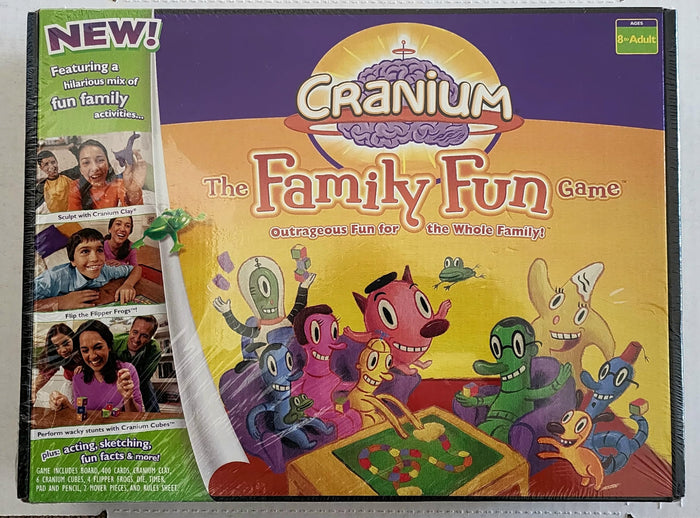
    Cranium Family Edition is the team version built for mixed ages. Every challenge comes from one of four decks — Creative Cat, Data Head, Star Performer and Word Worm — and points go to a team rather than a player, which is the whole design. The board is shorter than the original, the pace is quicker, and it is rated for ages eight and up.

    What is in the box

    Four decks of cards covering sixteen activities, a lump of squishable clay for sculpting rounds, stacking cubes, and a set of plastic frogs that players are occasionally required to flip across the table. Two of those items sound gimmicky on paper and turn out to be the reason the game works: flipping a frog badly is funny in a way that answering a question badly is not, and a child who cannot answer the question can still land the frog.

    The team format is doing the heavy lifting

    This is the part worth understanding before you buy. In a normal quiz game, the weakest player loses continuously and stops wanting to play. Cranium splits skills across four very different categories, so the person who cannot sketch is usually the person who can spell backwards, and the team absorbs the gap. A younger child paired with an adult can contribute on acting and clay rounds and be carried on word rounds. The game is built so that losing is a team outcome, which is a much easier thing for an eight-year-old to sit with.

    Where it drags

    Clay is the first cost: it dries out, it gets under fingernails, and it needs to be put away properly or the next session starts with a lump of gravel. Setup takes a few minutes because the decks have to be sorted. And the game needs at least four players to feel like itself — with two it becomes a thin back-and-forth, and with three you are always one person short of a proper team split.

    The eight-plus rating is worth heeding for the reading, not for the content. Younger children can play on a team with an older reader, and the listing says as much, but a six-year-old holding their own card deck will struggle.

    If you want the opposite kind of evening

    Cranium sets teams against each other. If your household does better with everyone pulling on the same rope, Stardew Valley: The Board Game is cooperative — the group wins or loses together, which removes the tears entirely. Both live in the same games and puzzles aisle, and they suit different families.

    The details

    PlayersTeams, four or more works best
    Age8 years and up
    Contents4 card decks, clay, stacking cubes, flipper frogs
    Shipping weightAbout 4.5 kg

    Two questions that come up before buying

    Can two people play? Technically yes, and practically no. With two players you each control a team of one, which removes the mechanism the game is built on — the strong reader covering for the weak one. Four is the real floor.

    What age can actually join? Eight and up for reading a card unaided. A six-year-old can play on a team with an adult reading for them, and will contribute on the acting and clay rounds. Put a six-year-old alone with a card in their hand and the evening ends early.

    The Cranium Family Edition is in stock now. Buy it for a table of four, not for two.

  • Wooden Dolls vs Plastic: What You Actually Get

    Wooden Dolls vs Plastic: What You Actually Get

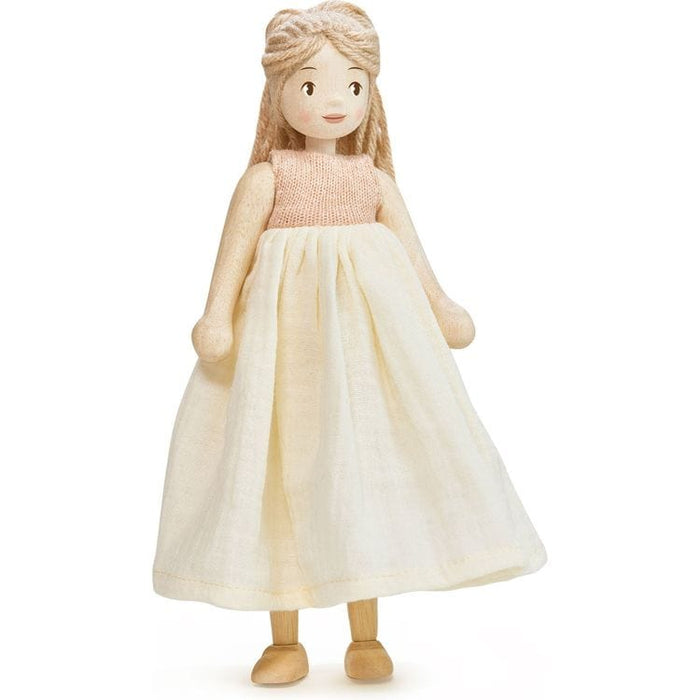
    Ferne is a 9.8-inch doll cut from solid rubberwood, with wool hair, arms and legs that rotate, and a muslin-and-knit outfit that comes off. Because the body is solid rather than hollow, she stands on her own without a stand. That single difference changes how a child plays with her. She is rated for ages three and up.

    What solid rubberwood changes

    A plastic doll is a shell. It is light, it tips over, and the joints are the weak point. A doll carved from rubberwood has weight in the legs and feet, which is why Ferne can stand upright on a shelf or a dollhouse floor. She also has no hollow seam to split, and the arms and legs turn at the shoulder and hip rather than clicking through preset positions.

    The wood itself comes from rubber trees, a by-product of latex production — the trees are felled when they stop yielding rather than cut for timber alone. That is the basis of the sustainability claim on the listing, and it is a more specific story than the word “natural” usually carries.

    The clothes are the actual activity

    Ferne arrives dressed in muslin and a knitted layer, with cotton underpants underneath, and all of it comes off. Dressing a doll is fine-motor practice disguised as play: buttons, arm holes, pulling a sleeve over a rotating shoulder. The rotating limbs are not a decorative feature — they are what makes dressing possible without fighting the doll.

    At 9.8 inches she is noticeably taller than a dolls-house figure, which is deliberate. She is scaled to the Mulberry Mansion range rather than to a 1:12 house, so she reads as a character in the room rather than as furniture.

    Care is not the same as a plush

    You cannot put her in the washing machine. The instructions are to wipe with a damp cloth, skip cleaning solutions, and keep her away from fire. Wool hair will felt if it is soaked and rubbed, so treat the hair the way you would treat a wool jumper. This is worth knowing before a three-year-old decides the doll needs a bath.

    Who should not buy a wooden doll

    If the child wants something to sleep with, this is the wrong object. Wood is not cuddly, the hair is not for tugging, and the doll is designed to be stood up and dressed rather than carried around by one arm. For that job a soft toy is simply better, and the Cuddle + Kind Polly the Panda is the honest alternative for that job.

    If the child already narrates stories with small figures, though, a doll that stands still and looks back is more useful than one that flops. The rest of the plush and doll range splits roughly along that line.

    The specifics

    Height9.84 in.
    MaterialsRubberwood, muslin, wool hair
    Age3 years and up
    CareWipe with damp cloth, no cleaning solution

    The Ferne wooden doll is in stock now. Her companion Lola is sold separately.

  • A Bobblehead for the Night Toronto Retired No. 15

    A Bobblehead for the Night Toronto Retired No. 15

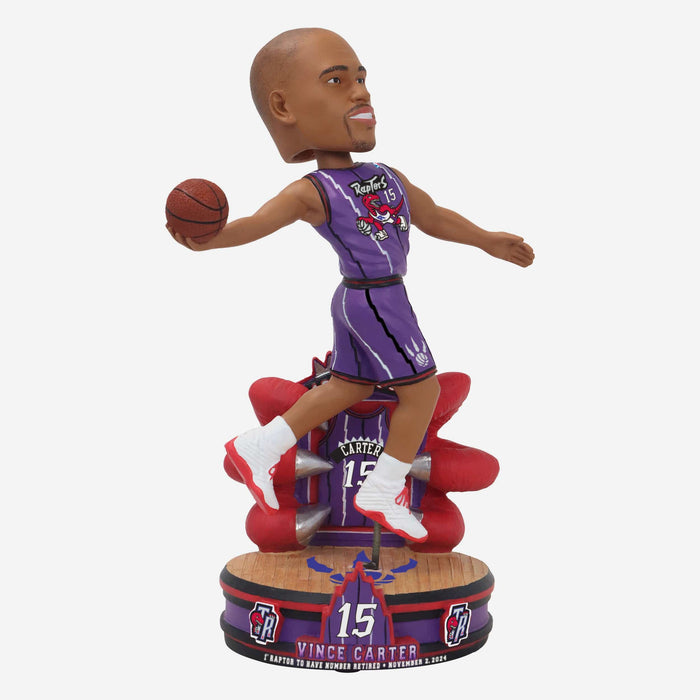
    The Toronto Raptors retired Vince Carter’s No. 15 on 2 November 2024 — the first number the franchise had ever retired. This bobblehead is built around that specific night rather than around the player in general: Carter in his blue gameday uniform, an eight-inch figure, standing on a court-textured base printed with the date and the words “1ST RAPTOR TO HAVE NUMBER RETIRED”. It is hand-painted rather than moulded in colour.

    What is actually printed on the base

    Most sports bobbleheads give you a figure and a name plate. This one uses the base as a display case. A frame at the back, held by a raptor claw, contains a jersey; the years “1998–2005” sit above it. Turn the piece around and the reverse of that backdrop carries his career stats. The base itself has a court texture, team colours, the logo on top and front, his number on the front, and the date of the ceremony along the bottom edge.

    That density of text is the tell. Someone designed this to be read up close, from a shelf, by a person who remembers the era — not to be glanced at from across a room.

    Why a retail bobblehead is not a giveaway bobblehead

    Arena giveaways are produced in the tens of thousands and handed out at the gate. Retail commemorative pieces are made in far smaller runs, and this one is hand-painted, which is why the listing warns that your piece may differ slightly from the photograph. Hand-painting on a figure this size means brush marks, small variations in the face, and a base that will not be identical to the next one off the line.

    The listing also carries a purchase limit of two per customer while it is on pre-order. Treat that limit as a signal about the size of the run rather than as marketing copy.

    Who it is for, and who it is not

    It is for the person who watched the 1998 to 2005 stretch and wants the moment on a shelf. It is also for collectors who buy the event rather than the player — the same instinct that makes a stadium giveaway from a specific night worth more than a nicer figure from an ordinary one. It is not for anyone expecting articulation or a toy. This is a statue on a spring, and it will not survive being played with.

    If you collect across sports rather than inside one fandom, the Ronald Acuña Jr. magnetised bobblehead is the same idea with a different league attached. Browse the rest of the action figures and collectibles if you are still deciding which night you want to own.

    Practical notes on displaying it

    HeightAbout 8 in., base included
    FinishHandcrafted, hand-painted
    LimitTwo per customer while on pre-order

    Keep it out of direct sun — painted resin fades unevenly and the blue uniform is the first thing to go. Set it at eye level so the base text is legible; the whole point of this piece is the reading. And keep the box. On limited commemorative runs the packaging is part of the object, and it is the first thing thrown away by people who later regret it.

    The Vince Carter jersey retirement bobblehead is in stock now.